The Iceman's Route: How an Entire Industry Melted Away the Moment Refrigerators Arrived

The Iceman's Route: How an Entire Industry Melted Away the Moment Refrigerators Arrived
Somewhere in the back of an old family photo album, there's probably a picture of a man in a heavy leather apron hauling a dripping block of ice up a front stoop. Most Americans today would look at it and have no idea what they were seeing. That man had a job title, a regular route, and customers who genuinely depended on him. He was the iceman — and before the 1930s, he was as essential to daily American life as the mailman.
What's easy to forget is that keeping food cold wasn't always a matter of plugging something in. For most of American history, it was a logistical operation involving frozen lakes, massive underground storage facilities, a fleet of horse-drawn wagons, and an entire working-class labor force whose entire livelihood revolved around a product that literally melted.
Harvesting the Cold
The American ice trade didn't start small. By the mid-1800s, it was a full-blown industrial enterprise — and New England was its capital. Every winter, crews descended on lakes across Massachusetts, Maine, and New York, scoring the frozen surface into grid patterns with horse-drawn cutters before prying out enormous blocks, sometimes two feet thick. The work was brutal, cold, and dangerous. Men fell through. Equipment failed. And yet the industry kept growing because the demand never stopped.
Frederic Tudor of Boston, often called the "Ice King," figured out in the early 1800s that natural ice could be shipped almost anywhere in the world if you packed it right. He was laughed at initially — the idea of shipping frozen water to tropical climates seemed absurd. But Tudor proved that sawdust and tight packing could preserve ice through long voyages, and suddenly Boston ice was landing in Havana, Calcutta, and New Orleans. By the 1880s, America was harvesting an estimated 25 million tons of ice per year.
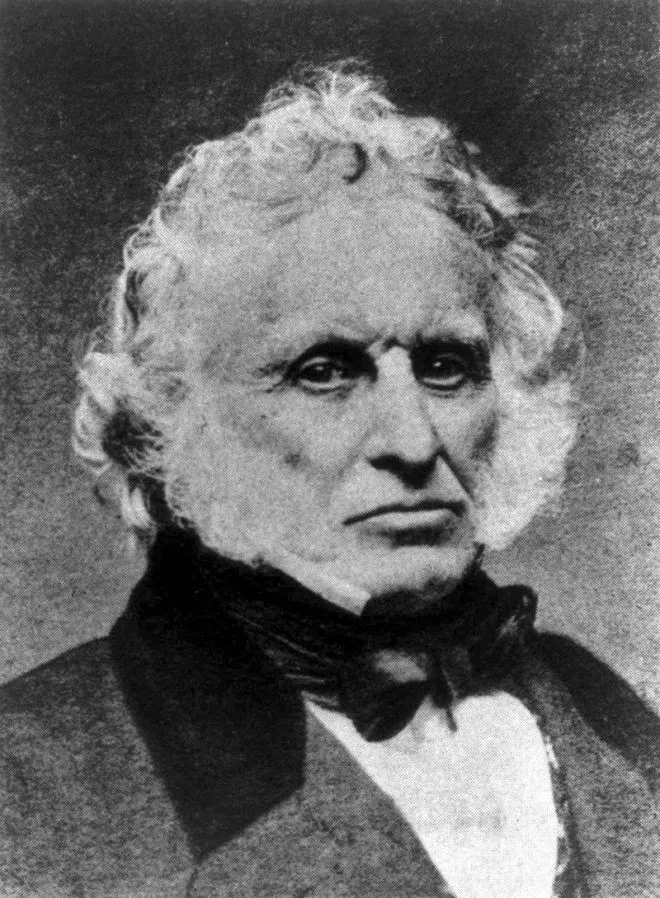 Photo: Frederic Tudor, via i0.wp.com
Back home, that ice went into icehouses — large, heavily insulated structures, often built half-underground, where blocks were stacked in sawdust and could survive well into summer. Cities had commercial icehouses. Wealthy households had private ones. And everyone else waited for the iceman.
The Iceman Cometh, Every Tuesday
For ordinary American families, the iceman was a fixture of neighborhood life. He came on a schedule — maybe twice a week in summer, less often in winter — and delivered blocks of ice that slid into the bottom compartment of a wooden icebox sitting in the kitchen. The icebox itself was a piece of furniture, often built to look like a cabinet, with a drip pan underneath that had to be emptied regularly or you'd have a puddle on the floor.
Kids in the neighborhood followed the ice wagon hoping to grab a sliver to suck on in the heat. Housewives would put a card in the window — marked with numbers on each side — to signal how many pounds they needed that day. The iceman would read the card from the street, hoist the right-sized block with iron tongs, and haul it up whatever stairs stood between him and your kitchen. It was physical, repetitive, and completely ordinary. Nobody thought of it as remarkable. It was just how things worked.
The icebox itself had real limitations. It kept things cool, not truly cold. Meat spoiled faster than it does today. Milk had a shorter window. Leftovers were a gamble. And every few days, you were managing a slow, steady drip of meltwater that reminded you the whole system was temporary.
The Electric Icebox Changes Everything
General Electric introduced its "Monitor Top" refrigerator in 1927, and while early models were expensive, the writing was already on the wall. Through the 1930s, as prices dropped and electricity spread into more American homes, families made the switch — and they didn't look back. By 1944, roughly 85 percent of American households that had electricity owned a mechanical refrigerator.
The iceman's route got shorter every year. Then it disappeared.
What's striking is how completely the industry collapsed. Not just the delivery jobs — the whole ecosystem. The lake harvesting operations, the icehouses, the wagon fleets, the tong manufacturers, the sawdust suppliers. An interconnected economy that had employed tens of thousands of people across the country essentially ceased to exist within a decade. Workers found other trades. The icehouses were repurposed or demolished. The ice cards came out of the windows for the last time.
Some of those men found work in the new refrigeration industry — servicing the very machines that had made them obsolete. It's a pattern America would repeat with every major technological shift that followed.
What the Icebox Taught Us
There's something worth sitting with in this story. The ice trade wasn't primitive. It was sophisticated, reliable, and deeply woven into the social fabric of American neighborhoods. The iceman knew which families were behind on payment, which kids would be waiting at the wagon, which back doors were always unlocked. He was part of the community in a way that a refrigerator compressor humming in the corner simply isn't.
The electric refrigerator gave Americans something genuinely better — more consistent cold, less daily management, no drip pan, no delivery schedule to work around. Nobody seriously mourns the icebox. But the speed with which an entire industry vanished, and the completeness with which it was forgotten, is its own kind of lesson.
We tend to think of the systems we live inside as permanent. The iceman's customers thought the same thing. Then one decade passed, and their grandchildren had never heard of him.