Small Hands, Hard Work: The Vanished World Where American Children Had Real Economic Weight

Picture a ten-year-old in 1890. He's up before sunrise. He's fed the chickens, hauled water, and is halfway through a second chore before most kids today have been nudged awake for school. By afternoon, he might be running deliveries for a local merchant, minding a younger sibling, or working a loom in a textile mill six days a week. His contribution to the family isn't supplemental. It's structural. Without it, the household budget doesn't balance.
Now picture a ten-year-old today. Soccer practice. Homework. A device in his hand. An adult coordinating his schedule.
Both of these childhoods are real. Only one of them is considered normal. And the distance between them is shorter than most people think.
The Working Child Was the Default Child
For the vast majority of human history — and well into American history — children were understood to be small people with economic utility. This wasn't cruelty. It was arithmetic. Families in agrarian economies needed labor, and children were labor. On a farm, every able-bodied person contributed to the work that kept the family alive. A child who could carry feed, pull weeds, or watch younger siblings while parents worked the fields was a child who was earning their place at the table in the most literal sense.
In colonial America, children were often apprenticed out by age seven or eight — sent to live and work in another household to learn a trade. This wasn't considered abandonment. It was considered preparation. The goal of childhood, to the extent anyone thought of it as a distinct phase at all, was to produce a competent adult as quickly as possible.
As America industrialized through the 1800s, child labor moved off the farm and into factories, mines, and mills. Children wound bobbins in textile plants across New England. They sorted coal in Pennsylvania mines, working in spaces too small for adults. They sold newspapers on city street corners, ran errands for merchants, and worked in canneries along the Gulf Coast. By 1900, roughly two million American children between the ages of ten and fifteen were recorded as working in industry — and that figure almost certainly undercounted the reality.
 Photo: New England, via c8.alamy.com
The Reformers Who Reimagined Childhood
The shift didn't happen because families suddenly decided children deserved more leisure. It happened because reformers, photographers, and eventually legislators made a sustained argument that what was happening to working-class children was morally unacceptable — and because economic conditions eventually made that argument winnable.
Photographer Lewis Hine is one of the most important figures in this story. Working for the National Child Labor Committee in the early 1900s, he documented child workers across the country with a camera he sometimes smuggled into facilities under false pretenses. His photographs — hollow-eyed boys in mine shafts, small girls dwarfed by industrial machinery — created a visual record that was impossible to argue with. Americans who had never thought much about where their manufactured goods came from were suddenly confronted with the faces of the people making them.
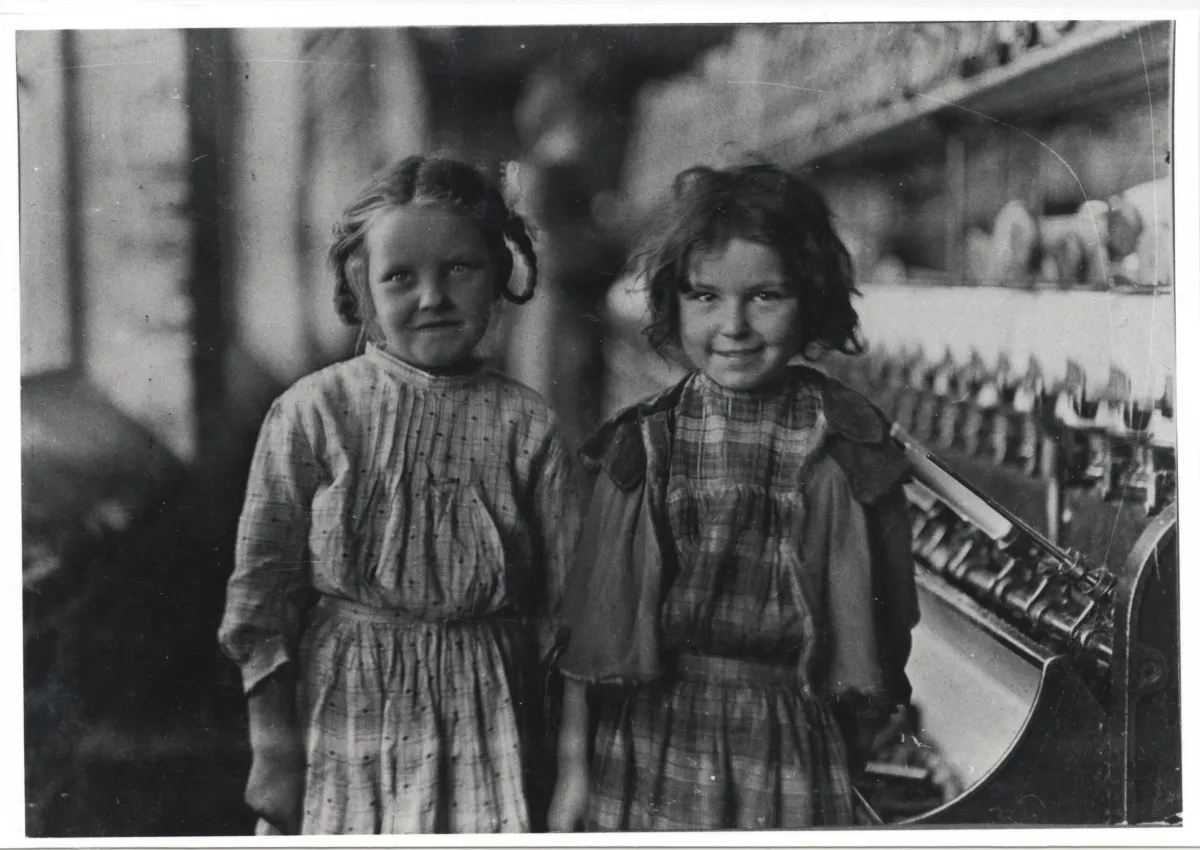 Photo: Lewis Hine, via umbc.edu
The Fair Labor Standards Act of 1938 finally established federal limits on child labor, setting minimum ages for various types of work and capping the hours minors could be employed during school periods. It was a genuine turning point. But it didn't arrive in a vacuum — it came after decades of compulsory schooling laws had already begun reshaping the expectation that children's daytime hours belonged to education rather than employment.
School as the New Structure
Compulsory education laws spread across American states through the late 1800s and early 1900s, and their effect on childhood was profound. When a child's presence in a classroom became legally required for a set number of hours each day, the economic logic of pulling them out to work began to erode. Employers who had relied on child labor faced both legal pressure and a shrinking supply. Families who had depended on children's earnings were gradually supported by rising adult wages, social programs, and the broader prosperity of the 20th century.
The middle-class ideal of childhood — sheltered, educational, emotionally centered — spread downward through American society as prosperity made it accessible to more families. By mid-century, the notion that a child should be protected from economic pressure, free to play, and focused on learning had become not just an aspiration but a cultural expectation. A family whose child worked out of necessity wasn't seen as practical. It was seen as struggling.
What Changed, and What Got Complicated
The protections built around modern American childhood are real achievements. Children are not working in coal mines. They are not losing fingers in textile machinery. The suffering documented in Lewis Hine's photographs is not the suffering of today's children, and that matters enormously.
But the transformation came with its own complications, ones that are still being worked out. As children were removed from economic life, they were also removed from a certain kind of early competence. The farm kid who could manage animals, read weather, negotiate with a merchant, and make consequential decisions by age twelve developed a practical confidence that no classroom fully replicated. The child who ran a paper route learned scheduling, customer relations, and the basic logic of earning — lessons absorbed through experience rather than instruction.
Modern parenting culture has responded to this gap in various ways — allowances, chores, youth entrepreneurship programs, summer jobs for teenagers — but these feel noticeably different from the genuine economic weight that earlier generations of children carried. A teenager's summer job today is often understood as character-building. For a child in 1900, it was the family's rent.
The childhood we've built is more humane. It is also, in certain ways, more insulated from reality than any previous generation of children ever experienced. Whether that insulation is entirely a gift — or whether it carries its own costs — is a question American families are still quietly answering.