The Empty Parking Lot Classroom: When Learning to Drive Was Something Your Dad Just Did
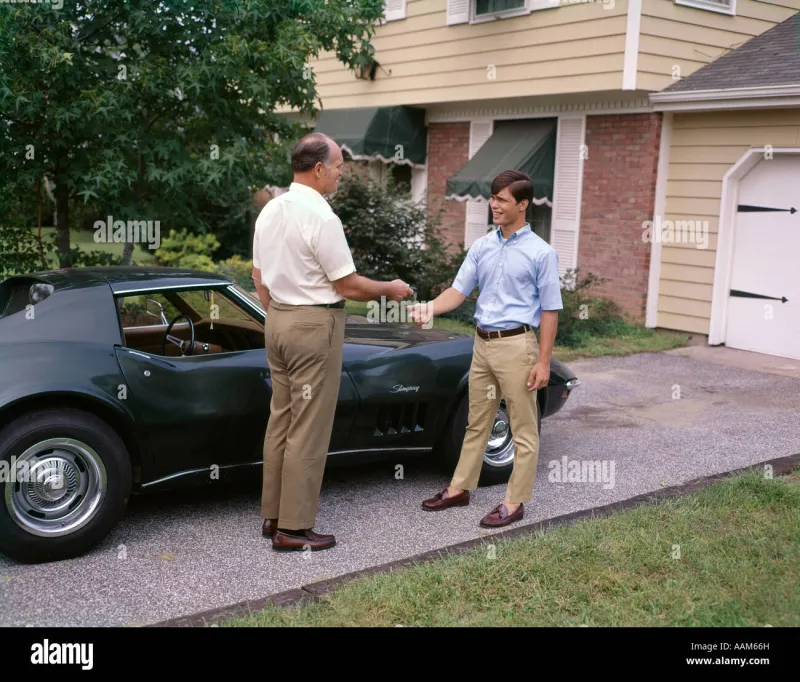
Photo: father teaching teenager to drive empty parking lot 1970s vintage, via c8.alamy.com
If you learned to drive before roughly 1980, there's a decent chance your instructor had no formal qualifications whatsoever. He probably wore a flannel shirt. He almost certainly said "easy, easy" about forty times. He may have grabbed the dashboard once or twice in a way he'd never fully admit. And at the end of the lesson, he probably took you for ice cream, because you both needed it.
That was driver's education in America for most of the 20th century — informal, personal, occasionally terrifying, and entirely embedded in family life. The idea that you'd pay a stranger in a dual-brake car to teach your kid how to drive would have struck most parents of that era as strange, even a little cold.
Something changed. And it's worth understanding what.
The Sunday Lot and the Quiet Country Road
For much of the postwar era, the American driving lesson followed a recognizable geography. It started in the emptiest space a parent could find — a church parking lot on Sunday evening, a school lot in August, a quiet industrial road on a Saturday morning. The car was usually the family's only car, which added a layer of stakes that no rental fleet vehicle can replicate.
Dad — and it was usually Dad, though not always — would explain the basics with the particular mix of confidence and anxiety that only a parent can project simultaneously. You'd creep forward. You'd brake too hard. You'd drift toward the curb. He'd say something like "you're doing great" in a voice that suggested the opposite. You'd try again.
Eventually, you graduated to real streets. Then the highway. Then, finally, the DMV parking lot, where the examiner with the clipboard would decide whether your father's months of white-knuckled instruction had been sufficient.
It wasn't a system. It was a tradition. And traditions, for better and worse, carry things that systems can't.
How Driver's Ed Became a Classroom Subject
Formal driver's education actually has a longer history than most people realize. High school driver's ed programs began appearing in the 1930s, championed by safety advocates who argued that trained teenage drivers would reduce the carnage on American roads — which was genuinely alarming by mid-century. By the 1950s and 1960s, in-school driver's ed had become widespread, often subsidized by state governments and taught by gym teachers or coaches who'd been given a brief certification course.
This was the hybrid era: school programs taught the rules of the road and basic technique, but parents still filled in the gaps with real-world practice. The family parking lot session didn't disappear — it just got supplemented.
The real commercialization came later, as states began cutting school budgets in the 1980s and 1990s and driver's ed programs were among the first casualties. When the school stopped offering it, private driving schools stepped in to fill the void. Today, the commercial driver's education industry generates billions of dollars annually. In most states, completing a certified course is either required for a license or earns a meaningful insurance discount — which amounts to the same thing economically.
The guy in the flannel shirt has been replaced by a liability-insured professional in a vehicle equipped with an instructor brake pedal.
What the Parking Lot Actually Taught
Here's what gets lost in the efficiency argument for formal driver's ed: the parking lot lesson was never really just about driving.
It was one of the few remaining rituals in American life where a parent and a teenager were forced into a small space together, working on something real, with genuine consequences if it went wrong. The driving was almost incidental. What was actually being transmitted was harder to name — something about responsibility, about trust, about the moment a parent decides to let go of the wheel.
There was a specific kind of communication that happened in those cars. Parents who struggled to talk to their teenagers about anything meaningful somehow found language when they were both staring through the windshield at the same road. Psychologists have a term for this: "side-by-side" conversation, as opposed to face-to-face. It turns out humans often speak more freely when they're looking at something other than each other. The car was an accidental therapy room.
The family driving lesson also transmitted something about local knowledge that a standardized curriculum can't replicate. Dad knew which intersections were tricky in rain. He knew that the light at the bottom of the hill changed faster than it looked. He knew the neighborhood, and he taught you the neighborhood. That's not in any workbook.
The Broader Pattern
The commercialization of driver's education is part of a larger story about how America has progressively outsourced the transmission of practical skills from families and communities to certified professionals.
Cooking classes replaced mothers teaching daughters. YouTube tutorials replaced fathers showing sons how to change a tire. Financial literacy apps replaced grandparents explaining how money worked. In each case, the argument for the professional version is the same: it's more standardized, more consistent, more measurable. And in each case, something that lived in the relationship gets quietly left behind.
This isn't a straightforward argument for going backward. Standardized driver's education probably does produce safer drivers in some measurable sense — the research is genuinely mixed, but the intent is sound. And plenty of family parking lot sessions produced drivers who picked up bad habits that lasted for decades.
But the question isn't only whether the professional version is better at the task. It's what else the family version was doing that we didn't notice until it was gone.
The Keys Are Still in the Ignition
Some families still do it the old way — or at least a hybrid version. The commercial driving school handles the certification, and then Dad takes over for the real education: the night driving, the highway merges, the parallel parking on a crowded street downtown that no instructor has time for.
That's probably the honest best of both worlds. But it requires a parent who makes the time, and in an era when family schedules are fractured and screen time fills every gap, the Sunday parking lot session is increasingly the kind of thing that just doesn't happen unless someone decides it matters.
Decide it matters. The lessons learned in that car go a lot further than the driveway.