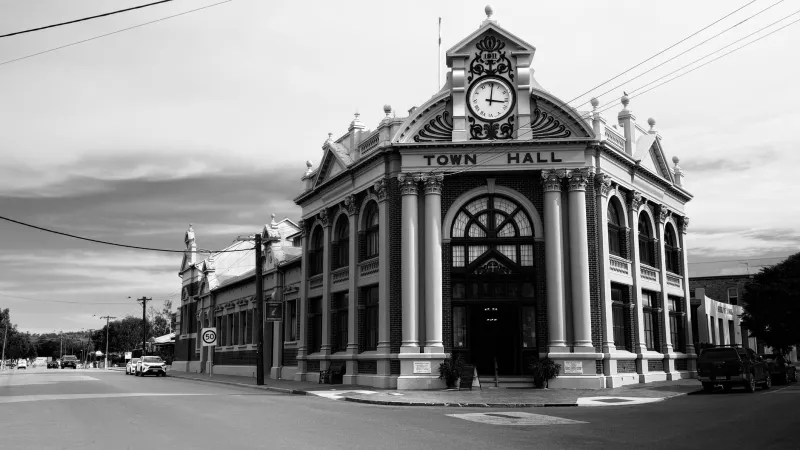
There's a photograph taken in downtown Cincinnati in 1908. In the foreground, a man in a flat cap is walking briskly along the sidewalk. In the background, barely visible above the awnings and trolley wires, the courthouse clock tower rises over the street. You can read the time from where the photographer was standing. So could every person on that block, and the block after that, and the one after that.
Nobody in that photograph is checking a pocket. Nobody needs to. The time belongs to everyone.
The Architecture of Shared Time
For most of American history, knowing what time it was required looking up — literally. Time was written into the built environment in ways that were impossible to miss.
Courthouse clocks were the anchors of small-town life. Built deliberately high so they could be seen from a distance, they were often the most expensive single feature of a county seat's civic architecture. The clock wasn't decoration. It was infrastructure. When the county courthouse was designed, the clock tower wasn't an afterthought — it was the point.
Church bells served the same function for centuries before clockfaces were common. A bell ringing at seven meant get up. A bell at noon meant eat. A bell at six meant the workday was done. You didn't need to own a watch. The bell told you, and it told your neighbor, and it told the farmer three fields over. Time was announced. It was communal. It was public property in the most literal sense.
Factory whistles carried this tradition into the industrial age. Mill towns across New England and the South organized their entire daily rhythm around the whistle. It blew when the shift started. It blew when lunch began. It blew when the day ended. Workers walking to the mill in the dark didn't check the time — they listened for it. The whistle was the town's clock, and the town built itself around the whistle.
Jewelers were the other great public timekeepers. A well-maintained clock in a jeweler's window was a civic service as much as an advertisement. Jewelers regulated their clocks carefully — they were, after all, in the business of selling precision — and townspeople relied on them. You walked past the jeweler's window to check the time the way you might check a weather app today. It was just part of moving through the day.
The Town Square as a Timekeeping Device
It's worth thinking about what all of this meant for the physical design of American towns.
The courthouse square wasn't just a political symbol. It was a practical organizing principle. Buildings clustered around it partly because that's where the clock was. Merchants set up near the square because foot traffic was high. Foot traffic was high because the square was the town's central reference point — for civic life, for commerce, and for time itself.
The clock tower made the center of town the center of town. It gave the layout a logic that was legible to anyone who arrived. You didn't need a map. You looked for the tower, and you knew where you were — in space and in time simultaneously.
This is something that's easy to underestimate when you think about historic downtowns and why they had the particular energy they did. People converged on them not just to shop or conduct business but because that's where the information was. And time was information.
The Slow Privatization of the Clock
Pocket watches had been around since the 16th century, but for most Americans they remained luxury items well into the 19th century. The Waltham Watch Company and later Ingersoll made affordable watches available to working Americans after the Civil War — Ingersoll's dollar watch, introduced in the 1890s, put personal timekeeping within reach of almost anyone.
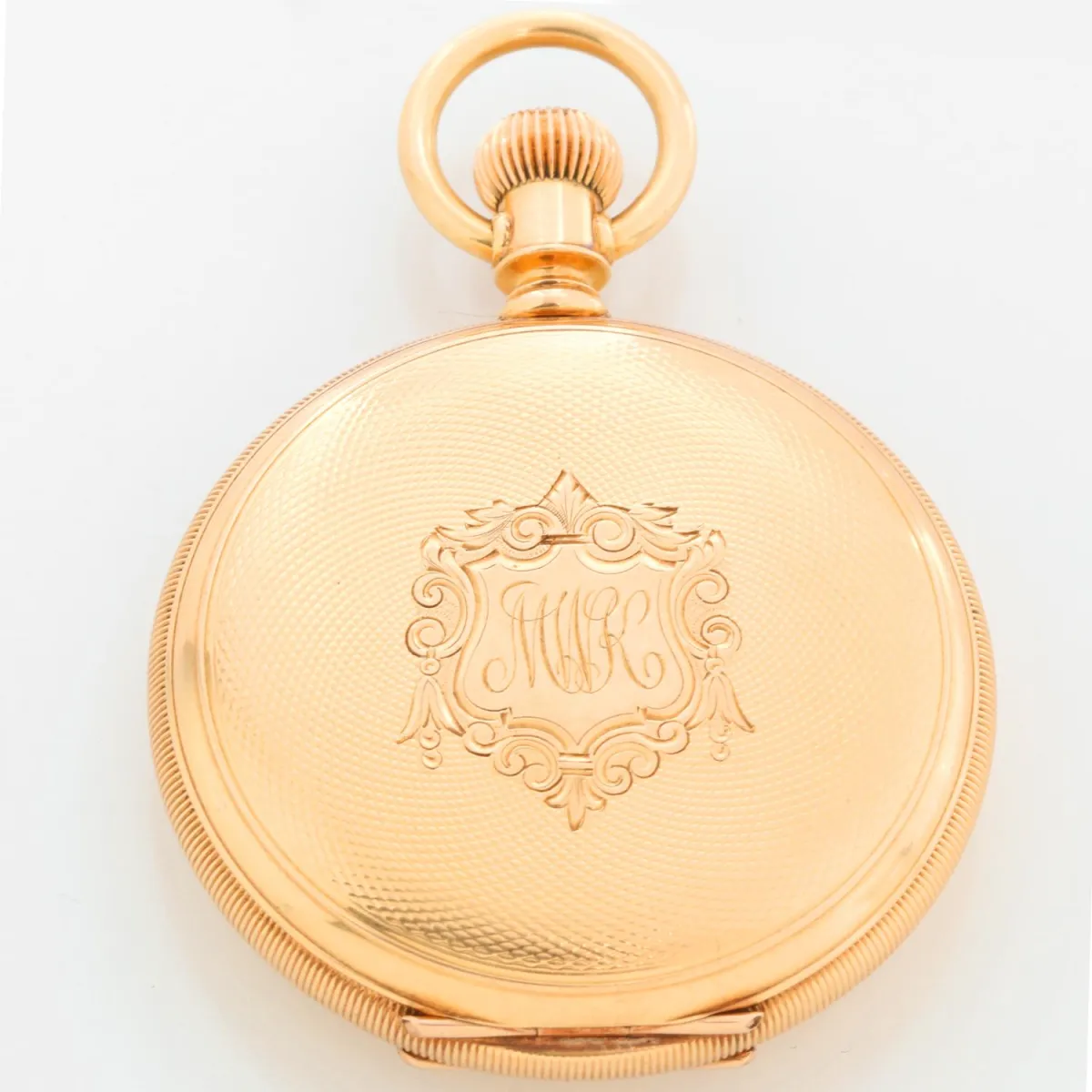 Photo: Waltham Watch Company, via a.1stdibscdn.com
But cheap personal watches didn't immediately kill the public clock. For decades, both coexisted. You might own a watch, but you still glanced at the courthouse tower to confirm it. The public clock was the standard against which private clocks were checked. It was the authority.
The wristwatch, popularized during World War I when soldiers needed to check the time without fumbling in a pocket, shifted things further. By the 1920s, wristwatches were fashionable and common. The personal clock was now always visible, always present, literally strapped to your body.
And yet the courthouse clocks kept running. The church bells kept ringing. As late as the 1970s and 1980s, factory whistles were still a feature of mill town life in parts of the South and Midwest. The shared infrastructure of time didn't disappear overnight. It faded slowly, the way useful things often do — not abolished but simply used less, maintained less, and eventually ignored.
When the Phone Became the Clock
The smartphone finished the job.
Today, virtually every American carries a device that displays the time continuously, synchronized to atomic precision via satellite, never wrong by more than a fraction of a second. It is, by any technical measure, the most accurate personal timepiece in human history. It requires no winding, no setting, no adjustment. It just knows.
And because everyone has one, the public clock has become largely ornamental. Courthouse towers still stand — many have been lovingly restored as historic features — but they're photographed more often than consulted. The jeweler's window clock is a nostalgic gesture. The factory whistle is a museum exhibit.
Time is no longer something the town tells you. It's something your phone tells you, privately, individually, in a transaction that involves no one else.
What a Clock Tower Actually Did
Here's the thing about the courthouse clock that isn't obvious until you think about it: it required you to share a moment with the people around you.
When you looked up at the tower to check the time, so did the person next to you. You both knew what time it was because you both looked at the same thing. Time was a shared fact, confirmed by shared reference. It was a tiny, trivial act of civic participation — but it happened dozens of times a day, for millions of people, for generations.
The smartphone makes timekeeping perfectly accurate and perfectly solitary. You check your phone. The person next to you checks their phone. You're both right. You've shared nothing.
This isn't a catastrophe. It's not even close to one. But it's a small, quiet example of something that happened over and over as the 20th century became the 21st — the slow migration of shared civic resources into private devices. The commons got smaller. The individual got more self-sufficient. And the town square lost one more reason to hold people in common.
Somewhere in downtown Cincinnati, the courthouse clock is probably still running. It still tells the time.
Hardly anyone looks up anymore.