House Calls, First Names, and the Doctor Who Knew Your Whole Family
House Calls, First Names, and the Doctor Who Knew Your Whole Family
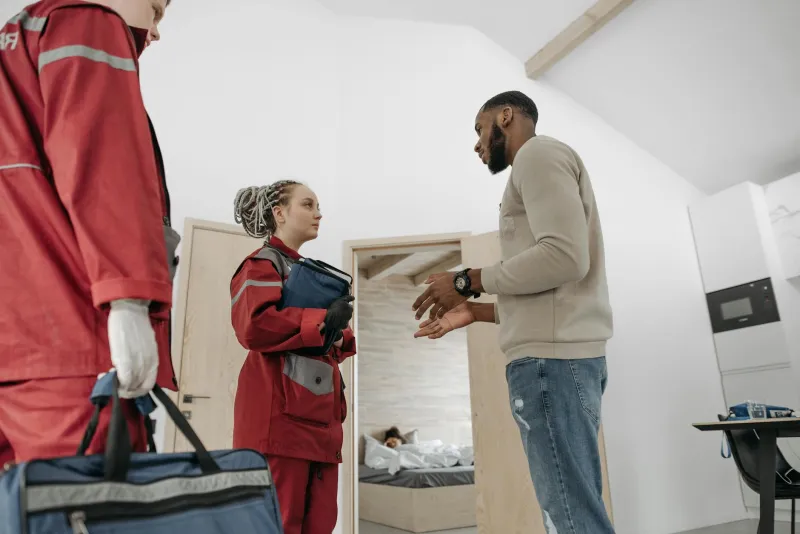
Picture this: It's 1958. Your kid wakes up with a fever, and by mid-afternoon, your family doctor is standing in your living room, stethoscope around his neck, asking how everyone else in the house has been feeling. He knows your mother's arthritis history. He was there when your youngest was born. He'll probably stop by again tomorrow just to check.
Now picture this: It's 2024. You've been trying to book an appointment for six weeks. The earliest slot available is with a physician's assistant you've never met. You'll get twelve minutes, maybe fifteen if you're lucky, and you'll spend part of that time watching them type into a screen.
Something shifted in American medicine — quietly, gradually, and with consequences most of us are still sorting through.
When the Doctor Came to You
The house call wasn't a luxury in mid-20th century America. It was standard practice. As recently as 1930, roughly 40 percent of all physician visits took place in the patient's home. Doctors built their practices around neighborhoods, not office buildings. They knew their patients the way a neighbor knows a neighbor — by name, by history, by the particular way a family tends to fall apart under stress.
This wasn't just warm and fuzzy nostalgia. There was a real clinical logic to it. A doctor who visited your home could see things no waiting room ever revealed: the mold on the bathroom ceiling, the stress in a household, whether the fridge actually had food in it. Context mattered, and house calls delivered context.
The relationship was personal in ways that are almost hard to imagine now. Many family doctors carried sliding-scale fees, charging less to families who couldn't afford much. Some accepted payment in goods or services. The idea that healthcare was a relationship — not a transaction — wasn't idealistic. It was just how things worked.
What Broke the Model
The shift away from house calls didn't happen because doctors got lazy or patients got demanding. It happened because medicine got dramatically more complicated — and more expensive to practice.
By the 1960s and 70s, diagnostic technology was advancing fast. X-rays, blood panels, EKGs — none of that fits in a black bag. Hospitals and clinics became the logical place to consolidate equipment, staff, and expertise. The economics followed. Office-based care was simply more efficient at scale. A physician seeing patients in a clinic could handle three times as many appointments in a day as one driving between homes.
Medicare and Medicaid, introduced in 1965, transformed the financial architecture of American healthcare almost overnight. Insurance-based billing created new administrative layers. Reimbursement structures rewarded volume and procedure over relationship and time. The house call, which was hard to bill and impossible to scale, quietly disappeared from the system.
By 1980, house calls accounted for less than one percent of physician visits. The doctor who knew your whole family had become, for most Americans, a character from a different era.
The Modern Appointment and Its Discontents
Today's healthcare system is, in purely technical terms, extraordinary. The diagnostic tools available to a physician in 2024 would have seemed like science fiction to a doctor in 1955. We can detect cancers earlier, manage chronic conditions more precisely, and perform surgeries that were unthinkable two generations ago.
But access? That's a different story.
The United States is facing a primary care physician shortage that experts say will reach 68,000 doctors by 2036, according to projections from the Association of American Medical Colleges. In rural areas, the gap is already severe. In many urban neighborhoods, it's not much better. The average wait time to see a primary care doctor in major American cities now runs between 20 and 26 days. Some patients report waiting months.
And when you do get in, the clock is running. The average primary care visit in the US lasts about 18 minutes. Doctors are often managing panels of 2,000 patients or more. The pressure to process, document, and move on leaves little room for the kind of unhurried conversation that used to be the whole point.
Burnout among physicians has reached alarming levels — a 2023 Medscape survey found that more than half of American doctors reported feeling burned out. The system that replaced the house call wasn't just less personal. In many ways, it became harder on everyone inside it.
The Trade-Off Nobody Voted On
Here's the uncomfortable truth: we didn't consciously choose this. Nobody held a national vote on whether Americans would prefer a fragmented, appointment-heavy system over a personal, accessible one. The shift happened through a thousand separate decisions — economic, technological, regulatory — none of which, individually, seemed like they were dismantling something irreplaceable.
What we gained is real. Modern medicine saves lives that would have been lost in 1958. The cancer you can catch early now, the infection that can be cleared in days with the right antibiotic, the heart condition managed through medication rather than a fatal event — these are not small things.
But what we lost is also real. The doctor who knew your name. The visit that happened in your home, on your terms. The sense that medical care was a relationship you could count on, not a system you had to navigate.
Some of that is coming back in unexpected forms. Telehealth, expanded dramatically during the pandemic, has restored something of the house call's convenience — if not its intimacy. Concierge medicine practices, for those who can afford them, offer the unhurried attention that used to be standard. Direct primary care models are quietly growing, trying to rebuild the doctor-patient relationship outside the insurance framework.
The technology got better. The access got harder. Whether we can find a way to have both — that's the question American medicine is still trying to answer.