Six O'Clock Sharp: When American Families Actually Ate Together Every Night
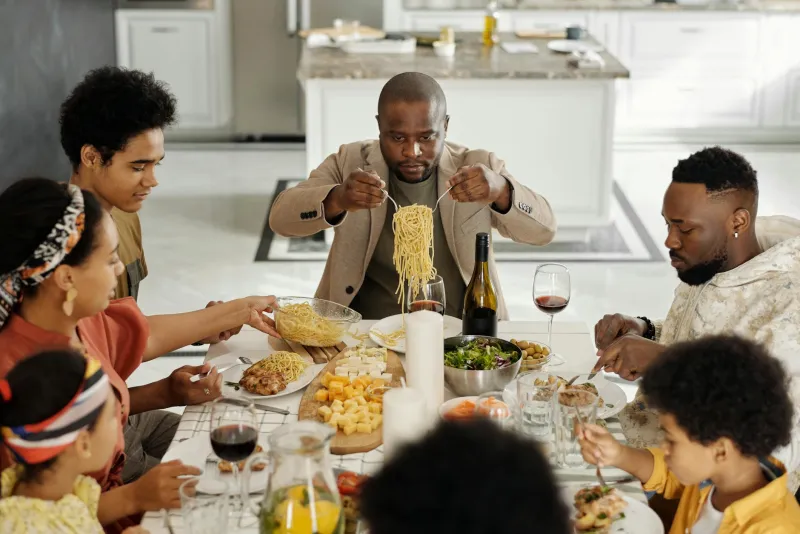
The Sound of Silverware and Stories
Every evening at 6 PM sharp, the Hendersons gathered around their Formica kitchen table. Dad had hung up his hat, Mom had turned off the radio, and the three kids had reluctantly abandoned their outdoor adventures. For the next hour, the outside world ceased to exist. There were no interruptions, no distractions, and definitely no television—that stayed firmly planted in the living room.
This wasn't unusual. In 1960, nearly 90% of American families ate dinner together every single night. It wasn't a special occasion or a weekend treat—it was as routine as brushing teeth or making beds. The dinner table was command central for American family life, where the day's events were dissected, tomorrow's plans were made, and children learned the unspoken rules of adult conversation.
More Than Just Food
The family dinner table functioned as America's most democratic institution. Parents and children sat as equals, sharing the same food and breathing the same air. Conversations meandered from school projects to workplace gossip, from neighborhood drama to national news. Kids learned to listen, to wait their turn, and to articulate their thoughts to an audience that couldn't simply scroll away.
Mealtimes were negotiations in real-time. "Eat your vegetables and you can have dessert." "Finish your story about the math test." "No, we're not getting a dog, but let's talk about why you want one." These weren't just family rules being established—they were lessons in compromise, persuasion, and patience.
The dinner table was also where family mythology was born. Stories were told and retold until they became legend: the time Dad got lost on the family vacation, Mom's disastrous attempt at homemade pizza, or little Tommy's first day of school. These stories created shared history, binding families together through collective memory.
The Slow Dissolution
The cracks in America's dinner table tradition appeared gradually. In the 1970s, more mothers entered the workforce, making the 6 PM deadline increasingly difficult to meet. Fast food restaurants proliferated, offering convenient alternatives to home-cooked meals. Television programming expanded, creating more compelling distractions during the dinner hour.
By the 1980s, the microwave had revolutionized meal preparation, allowing family members to eat at different times according to their individual schedules. The concept of "family dinner" began to fragment into "whenever you're hungry, heat something up."
The 1990s introduced another disruption: extracurricular activities. Children's schedules became packed with soccer practice, piano lessons, and tutoring sessions. Parents found themselves eating dinner in minivans between activities, passing drive-through bags to kids in the backseat.
The Digital Death Blow
The smartphone delivered the final blow to the American family dinner. Even when families managed to gather around the table, attention was divided between the people present and the digital world in their pockets. Conversations competed with text messages, news alerts, and social media notifications.
Restaurants began installing charging stations at tables, acknowledging that diners expected to stay connected throughout their meals. The phrase "no phones at dinner" became a house rule that required enforcement, rather than an assumption that went without saying.
Food delivery apps eliminated even the pretense of gathering in one location. Family members could order different meals from different restaurants, eating at different times in different rooms while consuming different content on their individual screens.
The Numbers Tell the Story
The statistics reveal the magnitude of this cultural shift. In 1960, the average American family ate together 7 times per week. By 2000, that number had dropped to 4.9 times per week. Today, only about 30% of American families manage to eat dinner together most nights of the week.
The time spent at the table has also shrunk dramatically. In the 1950s, family dinners typically lasted 60-90 minutes. Modern family meals average just 20 minutes, often interrupted by phones, television, or the need to rush to evening activities.
Even the definition of "eating together" has evolved. Many families now consider it a shared meal if they're eating the same food while watching the same television show, even if no conversation occurs.
What We Lost in Translation
The decline of the family dinner represents more than just a change in eating habits—it reflects a fundamental shift in how American families connect and communicate. Research consistently shows that children who regularly eat dinner with their families have better academic performance, lower rates of substance abuse, and stronger emotional bonds with their parents.
The dinner table served as a training ground for social skills that are increasingly rare in digital communication: reading facial expressions, interpreting tone of voice, and engaging in real-time dialogue without the ability to edit or delete responses.
Family dinners also provided structure and predictability in children's lives. Knowing that the family would gather every evening at 6 PM created a sense of stability and belonging that many modern children lack.
The Stubborn Survivors
Despite the broader cultural trends, some American families have maintained the tradition of regular family dinners. These holdouts often report that mealtimes remain their most important family ritual, providing daily opportunities for connection that might otherwise be lost in busy schedules.
Some families have adapted the tradition to modern realities, establishing "device-free zones" during meals or designating certain nights of the week as mandatory family dinner nights. Others have moved the tradition to breakfast or weekend meals, working around schedules that make evening gatherings impossible.
The COVID-19 pandemic temporarily reversed the trend, as lockdowns forced families to eat together more frequently. Many parents rediscovered the value of shared meals, leading to a brief resurgence in family dinner participation.
The Price of Convenience
The transformation of American eating habits from communal to individual reflects broader changes in how we prioritize time and convenience. The efficiency gained by eating separately—no need to coordinate schedules, no arguments about menu choices, no pressure to make conversation—comes at the cost of the social and emotional benefits that shared meals provide.
We've gained flexibility and lost ritual. We've gained convenience and lost connection. We've gained individual choice and lost collective experience.
The American dinner table, once the center of family life, has become just another piece of furniture in many homes—a surface for homework, mail sorting, and device charging rather than the gathering place where families came together to share food, stories, and time.
In rushing toward more efficient ways of living, we may have left behind one of the simplest and most effective tools for building strong families: the daily ritual of sitting down together and sharing a meal.